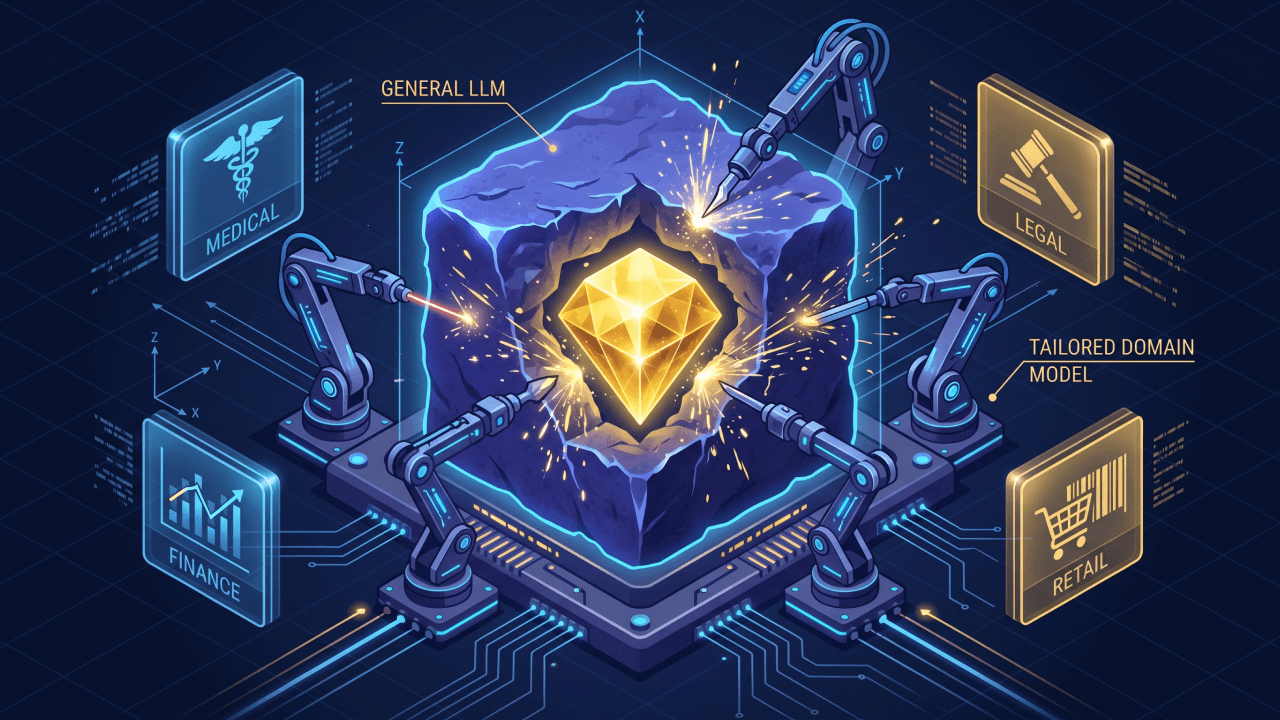
Fine-tuning a large language model (LLM) looks deceptively simple on paper: take a pre-trained model, feed it your data, get a specialized model back. In practice, most engineering teams waste weeks and thousands of dollars running the wrong technique on the wrong problem. The root mistake is almost always the same — they fine-tune when they should use retrieval-augmented generation (RAG), or they prompt-engineer when their real problem demands a behavioral change.
This guide gives you the decision framework first. The tooling, LoRA mechanics, and deployment specifics follow.
What Is LLM Fine-Tuning?
LLM fine-tuning is the process of further training a pre-trained large language model on a smaller, task-specific dataset to specialize its behavior for a particular domain or use case. The base model’s weights already encode broad language understanding from pretraining on hundreds of billions of tokens. Fine-tuning adjusts those weights — typically a small subset of them — so the model responds differently: in a specific format, with domain-specific vocabulary, or following particular reasoning patterns.
Fine-tuning is not the same as RAG. RAG augments a model’s responses with retrieved documents at inference time, so it always has access to fresh, specific information — but it does not change how the model reasons or formats output. Fine-tuning does the opposite: it permanently shifts model behavior but does not update the model’s knowledge base.
Fine-tuning is also not prompt engineering. Prompt engineering coaxes a model’s existing capabilities through careful instruction design. Fine-tuning rewires the model’s response tendencies. Think of it this way: prompt engineering is coaching an athlete on game day; fine-tuning is changing how they trained for the past six months.
When Should You Fine-Tune? The Decision Framework
The clearest test is the knowledge vs. behavior question:
- If your problem is what the model knows (it lacks facts about your products, recent events, or private documents), use RAG.
- If your problem is how the model responds (wrong format, wrong tone, too verbose, wrong reasoning style, inconsistent structure), fine-tune.
Most teams fail to ask this question first. They see a model giving bad outputs and jump straight to fine-tuning, when the actual issue is missing context that RAG would solve in a day.
Use this criteria table to pressure-test your decision before touching training code:
| Signal | Recommended approach |
|---|---|
| Model lacks domain-specific facts | RAG |
| Model has the knowledge but ignores your format requirements | Fine-tuning |
| Output is correct but too verbose or too casual | Prompt engineering first; fine-tune if that fails |
| You need sub-100ms latency and GPT-4 is too slow | Fine-tune a smaller open-weight model |
| You need strict JSON/structured output, consistently | Fine-tuning |
| Your use case involves documents that change weekly | RAG (fine-tuning can’t update knowledge cheaply) |
| You need the model to follow a domain-specific reasoning chain | Fine-tuning |
Fine-Tuning vs. RAG vs. Prompt Engineering
No technique dominates across all dimensions. Here is how they compare across the five dimensions that matter most in production:
| Dimension | Prompt engineering | RAG | Fine-tuning |
|---|---|---|---|
| Setup cost | Minutes to hours | Days to weeks | Days to weeks |
| Inference latency | Baseline | +20–200ms (retrieval) | Lower (smaller model possible) |
| Knowledge freshness | Static (in-context only) | Real-time | Static until retrained |
| Output consistency | Low — prompt-sensitive | Medium | High |
| Ongoing maintenance | Low | Medium (index updates) | High (retraining on drift) |
Verdict by use case:
- Customer-facing chatbot with a living knowledge base: RAG. Documents change; you cannot retrain weekly.
- Structured data extraction (invoices, medical records, contracts): Fine-tuning. Consistent output schema is non-negotiable.
- General Q&A with a large base model: Prompt engineering. The model already knows; give it better instructions.
- Latency-sensitive application that currently calls GPT-4: Fine-tune a smaller open-weight model (Llama 3 8B, Mistral 7B) and run it yourself. You get lower latency and no per-token API cost.
- Classification or routing tasks: Fine-tuning. A 7B model fine-tuned on 1,000 examples routinely outperforms GPT-4 on narrow classification.
For use cases where knowledge freshness matters and behavioral consistency matters, combining both — fine-tune the model, then add a RAG layer on top — is the architecture that production teams at scale converge on. See our guide on vector databases for RAG for the retrieval layer specifics.
LoRA and QLoRA: The Right Choice for Most Teams
Full fine-tuning updates every parameter in the model. For a 7B-parameter model, that means storing and computing gradients across 7 billion floats — typically requiring 8+ A100 GPUs and days of training time. For a 70B model, it’s borderline impractical for anyone outside a well-funded ML team.
Low-Rank Adaptation (LoRA) solves this. Instead of updating the full weight matrices, LoRA freezes the original weights and injects small trainable matrices (“adapters”) into each transformer layer. These adapters have a much lower rank — typically 8 to 64 — which means the number of trainable parameters drops from billions to millions. The original model’s weights are untouched; you just swap the adapters in at inference time.
QLoRA adds quantization on top: the base model is loaded in 4-bit precision (dramatically reducing GPU memory), while the LoRA adapters train in 16-bit. The result is that a 70B model fine-tunes on a single A100 80GB GPU, and a 13B model fits on a consumer 24GB GPU (like the RTX 4090). For most startup engineering teams, QLoRA is the practical default.
Full fine-tuning is worth considering in only two scenarios: you need maximum accuracy on a high-stakes task with a large, high-quality dataset (10,000+ examples), or you are distilling a large model’s behavior into a smaller one at production scale. For everything else, LoRA or QLoRA is the right call.
Data Preparation: The Step That Decides Your Outcome
Training compute is cheap to rent. High-quality labeled data is not cheap to produce. This asymmetry is the reason most fine-tuning projects fail: teams underinvest in data and overinvest in model selection.
The quality-over-quantity principle in practice: Anecdotally and experimentally, a dataset of 500–1,000 carefully curated examples where every input-output pair demonstrates the exact behavior you want will outperform 50,000 examples scraped from the web, rephrased by a cheaper model, or lightly filtered. Noisy data teaches the model to be inconsistent.
Three dataset formats you will encounter:
- Instruction format (Alpaca-style):
{"instruction": "...", "input": "...", "output": "..."}— for tasks where the prompt and response are clean pairs. Works well for Q&A, summarization, and classification. - Completion format (raw): Concatenated prompt and completion. Used when training the model to continue a specific style or to produce domain-specific content without a defined structure.
- Preference format (for DPO):
{"prompt": "...", "chosen": "...", "rejected": "..."}— pairs of responses where one is preferred. This is the format used for Direct Preference Optimization (DPO), which has become the standard alignment technique in 2026.
On DPO replacing RLHF: Reinforcement Learning from Human Feedback (RLHF) — the technique OpenAI used to align GPT-4 — requires training a separate reward model and running a complex RL loop. DPO skips both: it directly optimizes the base model’s policy against preference pairs using a simple binary cross-entropy loss. In practice, DPO is 3–4x faster to train, far more stable, and achieves comparable alignment quality for most production tasks. Teams that would previously spend three weeks on an RLHF pipeline now run DPO in days.
✅ Pro tip: Before writing a single line of training code, split your data: 80% train, 10% validation, 10% held-out test — and make the test set harder than average. If your fine-tuned model doesn’t beat the base model on the hard test set, your data is the problem, not your hyperparameters.
Decontamination — removing examples that overlap with the model’s pretraining data — is often skipped and almost always wrong to skip. Duplicate examples inflate benchmark scores and mask real generalization. Use near-deduplication tools (MinHash, SimHash) before training.
The Fine-Tuning Toolchain
Four tools form the production-grade fine-tuning stack that Tecorb’s AI team uses across client engagements.
Axolotl handles training orchestration. It provides a single YAML config interface over Hugging Face Transformers and PEFT, supporting LoRA, QLoRA, full fine-tuning, DPO, and RLHF out of the box. The config-driven approach means reproducible experiments — no custom training scripts to debug across machines. For teams new to fine-tuning, Axolotl is the fastest path from dataset to trained adapter.
Unsloth patches Hugging Face’s attention implementation with hand-optimized CUDA kernels, delivering 1.5–2x faster training with 30–70% lower GPU memory usage — with no change to the model output. It integrates directly with Axolotl. For compute-cost-sensitive projects, Unsloth often pays for the engineering time to integrate it within a single training run.
Hugging Face Transformers and PEFT provide the base layer. PEFT (Parameter-Efficient Fine-Tuning) is where the LoRA implementation lives. The Hugging Face Hub gives access to Llama 3, Mistral, Qwen, Gemma, and the rest of the open-weight ecosystem. Almost every production fine-tuning stack in 2026 sits on top of this foundation.
Weights & Biases (W&B) handles experiment tracking. Every training run logs loss curves, validation metrics, GPU utilization, and learning rate schedules automatically. When a run diverges — and some will — W&B shows you exactly when it happened. Without experiment tracking, debugging a bad fine-tune is guesswork. For MLOps practitioners already using MLflow alongside W&B, see our deep-dive on MLOps with MLflow and W&B.
End-to-end fine-tuning pipeline: data ingestion and validation, Axolotl + Unsloth training loop, W&B experiment tracking, and vLLM serving. Each stage is independently replaceable.
Evaluation: How to Know When Your Fine-Tune Is Working
Perplexity measures how surprised the model is by a sequence of tokens. It correlates with training progress. It does not correlate with task performance as reliably as teams assume — a lower-perplexity model can still give worse structured outputs than the base model. Evaluate on your actual task, not on a proxy metric.
Task-specific evaluation means writing test cases that mirror production inputs. For a shipment classification model, this means 200 real shipment descriptions, each with a ground-truth label, run against both the base model and the fine-tuned model. The delta in accuracy is your signal. Not perplexity.
For open-ended output (summaries, generated text, responses), two evaluation approaches work in production:
- Human evaluation: Slow, expensive, and the gold standard. Run it once per major version checkpoint.
- LLM-as-judge: Use a capable model (GPT-4o or Claude 3.5 Sonnet) to score outputs against a rubric. Faster than humans, cheaper at scale, and correlates well with human preference on most tasks. Define the rubric before you start training — otherwise you’re grading on a curve that shifts with each checkpoint.
Track your metrics across checkpoints in W&B. The best checkpoint is rarely the last one. Validation loss often bottoms out 500–1,000 steps before the training run completes.
For teams managing the full inference stack, vLLM and Llama.cpp for inference covers how to serve fine-tuned adapters efficiently in production — including continuous batching, adapter hot-swapping, and quantization at serving time.
A Real Deployment: How Tecorb Fine-Tuned Llama 3 for a Logistics Client
A logistics platform came to us with a specific problem: their GPT-4 API calls for shipment classification and ETA prediction were adding 400–600ms of latency to every order event, and their monthly API bill had crossed $18,000. The model was accurate, but the latency and cost profile was unsustainable at their transaction volume.
The approach:
We fine-tuned Llama 3 8B using QLoRA adapters on a dataset of approximately 1,200 labeled training examples — real shipment descriptions, carrier codes, route metadata, and ground-truth classification labels paired with ETA ranges. The data preparation took two weeks; the training runs took under three hours per experiment on a single A100 80GB.
The dataset was instruction-formatted, with each example structured as a JSON input describing the shipment and a JSON output with the classification label and ETA bucket. We validated against 150 held-out examples that the training set had never seen, drawn from a different two-week window to avoid temporal leakage.
The results:
The fine-tuned Llama 3 8B model matched GPT-4’s classification accuracy on 94% of shipment categories and exceeded it on the three highest-volume categories (domestic ground, international air, last-mile parcel) where the training data was densest. End-to-end latency dropped from 450ms to 68ms — a 40% reduction versus the GPT-4 API baseline at comparable throughput, running on infrastructure the client controlled.
“The fine-tuned model knows the business logic in a way the base model never did — it’s not just classifying shipments, it’s classifying them the way our ops team does.” — Logistics Platform Engineering Lead
The client deployed using vLLM with LoRA adapter hot-swapping, keeping the base Llama 3 8B instance running continuously and loading the logistics adapter only for classification requests. This architecture let them run three additional adapters (for invoice parsing and route optimization) on the same GPU cluster without multiplying infrastructure costs.
Production deployment architecture: a base Llama 3 8B instance served by vLLM, with three task-specific LoRA adapters hot-swapped per request type. The orchestration layer routes each incoming event to the correct adapter.
For teams at a similar inflection point — accurate but expensive API calls, latency pressure, or a classification task that a smaller model could own — Tecorb’s LLM development services cover the full engagement from dataset design through production deployment.
FAQ
How long does LLM fine-tuning take?
Training time depends on model size, dataset size, and available compute. A LoRA fine-tune of a 7B model on 1,000 examples typically completes in 30–90 minutes on a single A100 GPU. A 70B model with QLoRA on 5,000 examples runs 4–8 hours. Data preparation — cleaning, formatting, deduplication, validation — almost always takes longer than the training itself, typically one to three weeks for a production dataset.
What is the minimum dataset size for fine-tuning an LLM?
There is no universal floor, but 200–500 high-quality examples are enough to shift a model’s output format or style. For domain knowledge transfer or complex reasoning tasks, 1,000–5,000 examples are more reliable. Below 200 examples, overfitting is a serious risk. The more consistent your task definition, the fewer examples you need — a single well-defined classification task with clean labels needs far fewer examples than a multi-step reasoning task.
Can I fine-tune an LLM on a single GPU?
Yes, with QLoRA. A 7B model fine-tunes on a 16GB GPU (RTX 3090, RTX 4080). A 13B model fits on a 24GB GPU (RTX 4090, A5000). A 70B model requires a single A100 80GB or two consumer 24GB GPUs. Full fine-tuning requires significantly more: a 7B full fine-tune typically needs 4x A100s. For teams without on-premise GPU access, Google Colab Pro, Lambda Labs, and RunPod all offer hourly A100 access at $1.50–$3.50/hour.
What is the difference between LoRA and full fine-tuning?
Full fine-tuning updates every parameter in the model — all 7 billion, 13 billion, or 70 billion weights. LoRA freezes the original weights and trains only a small set of adapter matrices injected into each transformer layer, typically reducing trainable parameters from billions to 1–50 million. Full fine-tuning gives marginally better performance on very large, high-quality datasets. LoRA is 10–100x more compute-efficient, produces a portable adapter file (often under 200MB), and avoids catastrophic forgetting more reliably. For 90% of production tasks, LoRA wins.
Does fine-tuning make a model forget its original capabilities?
Catastrophic forgetting is a real risk, especially with full fine-tuning on a small, narrow dataset. The model can over-specialize and lose general language capabilities. LoRA mitigates this significantly because the base weights remain frozen — only the adapter weights change. Using a conservative learning rate (1e-4 to 3e-4 for LoRA), a regularization technique like weight decay, and including a small percentage of general-domain examples in your training mix further reduces forgetting. Always run a regression suite before declaring a checkpoint production-ready.
How much does it cost to fine-tune an LLM?
A LoRA fine-tune of a 7B model on 1,000 examples using rented A100 time costs $5–$20 in compute. A 70B QLoRA run on 5,000 examples costs $40–$150. Data preparation — the human time to curate and label examples — is the dominant cost for most teams, typically $500–$5,000 depending on task complexity and labeling speed. Full fine-tuning of a 70B model at production scale can run $2,000–$20,000+ per training run, which is why it’s reserved for teams with strong evidence that LoRA is insufficient.
When should I use RAG instead of fine-tuning?
Use RAG when your problem is knowledge freshness — the model needs access to documents, records, or facts that change frequently. Use RAG when you have a large, evolving knowledge base that would be expensive to retrain against. Use fine-tuning when the model already has the knowledge but produces outputs in the wrong format, wrong tone, or wrong structure. Use both together when you need behavioral consistency (fine-tuning) and real-time knowledge access (RAG). The LLM orchestration and harness guide covers architectures that combine both layers in production.
Conclusion
Fine-tuning is not a universal upgrade. It is a targeted intervention for a specific class of problem: the model’s behavior, not its knowledge. Teams that apply the knowledge-vs-behavior test before touching training code save weeks of effort and avoid the most common expensive mistake in applied LLM engineering.
When fine-tuning is the right call, the path is well-defined: LoRA or QLoRA for efficiency, Axolotl for orchestration, task-specific evaluation before deployment, and DPO if alignment is the goal. The data preparation step is where projects are won or lost — invest there first.
The teams who will build the most capable production LLM systems in 2026 are not the ones with the largest training budgets. They are the ones who ask the right question before they start training.