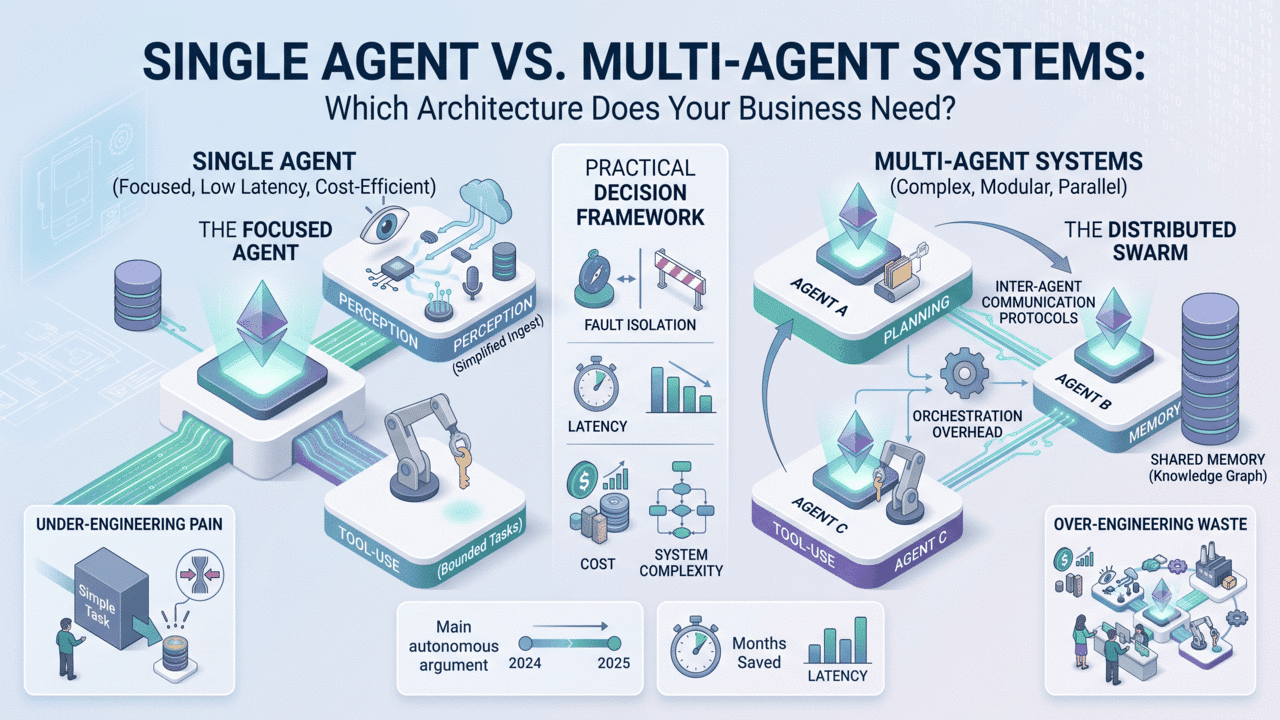
Single agents excel at focused, bounded tasks where latency and cost are critical. Multi-agent systems unlock capabilities that no single agent can handle alone. Choosing between single agent vs multi-agent systems is one of the most consequential architecture decisions a business makes when building with AI agents, and getting it wrong is expensive in both directions.
This post walks through the trade-offs in orchestration overhead, fault isolation, inter-agent communication protocols, and shared memory design. It gives you a practical decision framework to match your specific use case to the right architecture before you write a line of code.
Single Agent vs Multi-Agent Systems: The Quick Comparison
Before the detail, here is the decision at a glance. Most teams should start on the left column and only move right when they hit a concrete wall.
| Dimension | Single-agent system | Multi-agent system |
|---|---|---|
| Best for | Focused, bounded tasks in one context window | Large, diverse tasks needing decomposition |
| Latency | Lower — one reasoning loop | Higher — routing and message passing add hops |
| Token cost | Lower baseline | Several times higher for the same task |
| Fault isolation | Weak — one bad step poisons the run | Strong — orchestrator can retry or route around failures |
| Parallelism | None within a request | Independent branches run concurrently |
| Engineering complexity | Low | High — communication and shared memory to design |
| Right default | Yes, start here | Only when a single agent provably cannot cope |
The short version: pick a single agent by default, and earn your way into a multi-agent system with a specific, articulable reason.
What Is a Single-Agent System?
A single-agent system is one LLM-driven agent with a defined set of tools, a single reasoning loop, and one context window. It receives a request, plans, calls tools, and returns a result. There is no coordination cost because there is nothing to coordinate. Everything happens in one place with one source of truth.
Single agents are the right default for focused, bounded tasks: answering support questions from a knowledge base, extracting structured data from documents, drafting content, or executing a well-defined workflow with a handful of tools. When latency and cost matter, and the task fits inside one context window, a single agent almost always wins.
💡 Insight: The single-context-window constraint is the real dividing line, not task difficulty. A hard task that still fits in one window and one tool set belongs to a single agent. An easy task spread across three disconnected data domains often does not.
What Is a Multi-Agent System?
A multi-agent system decomposes a problem across several specialized agents that coordinate to reach a goal. A common pattern is an orchestrator agent that delegates subtasks to worker agents, each with its own tools, prompt, and sometimes its own model. Other patterns include hierarchical teams, peer-to-peer collaboration, and debate or critic setups where one agent reviews another’s output.
Multi-agent systems shine when a task is too large or too diverse for one context window, when subtasks benefit from genuine specialization, or when you need parallelism across independent branches of work. Deep research, large-scale code migration, and complex workflows that span many domains are natural fits. Frameworks like LangGraph and CrewAI exist specifically to manage this coordination so you are not hand-rolling a message bus.
Single Agent vs Multi-Agent Systems: The Core Trade-Offs
Every argument for or against a second agent reduces to four levers. Understand these and the decision usually makes itself.
Orchestration overhead
Every additional agent adds coordination cost: routing, message passing, and the tokens spent describing context to each agent. A multi-agent system can consume several times the tokens of a single agent for the same task — Anthropic reported its own multi-agent research system used roughly 15 times more tokens than a standard chat interaction. If your task does not need decomposition, that overhead is pure waste.
Fault isolation
Multi-agent systems can contain failures. If one worker agent fails or hallucinates, the orchestrator can retry, route around it, or discard the result. In a single agent, one bad reasoning step can poison the entire run. Fault isolation is a genuine advantage of multi-agent designs for high-stakes, long-running tasks.
Inter-agent communication protocols
Agents must exchange information reliably. This means defining message formats, deciding what context each agent needs, and handling the fact that agents cannot see each other’s internal state. Poorly designed communication leads to lost context, contradictory outputs, and cascading errors.
Shared memory design
Multi-agent systems need a strategy for shared state: a scratchpad, a vector store, a database, or a message bus. Deciding what is shared globally versus kept local to each agent is one of the hardest parts of multi-agent design, and it directly affects both correctness and cost.
⚠️ Watch out: Communication overhead scales worse than linearly. Each new agent can, in principle, exchange context with every other agent, so a five-agent free-for-all creates far more coordination surface than five times a single agent. Constrain the topology — a strict orchestrator-to-worker hierarchy beats a peer-to-peer mesh for most business workloads.
How Do You Choose Between Single-Agent and Multi-Agent Systems?
Start with a single agent, and reach for a multi-agent system only when you hit a concrete limit. Those limits are specific: the task does not fit in one context window, subtasks need different tools or models, you need parallelism to meet latency targets, or fault isolation is a hard requirement.
Ask these questions before adding agents:
- Can one agent with the right tools do this today?
- Does the task decompose cleanly into independent subtasks?
- Is the coordination cost justified by the capability gain?
- Can you name what the second agent does that the first cannot?
If you cannot articulate why a second agent earns its keep, you do not need it yet. This mirrors the readiness discipline in any serious AI consulting process — scope the problem before you scale the architecture.
Weighing an agent architecture for a real workload? See how Tecorb approaches AI and ML development and the criteria we check before recommending multi-agent orchestration.
When Companies Over-Engineer and Under-Engineer
The two failure modes are mirror images, and both are common enough that they deserve naming.
Over-engineering the architecture
One company built a five-agent system to answer customer support questions. The orchestration overhead tripled latency and cost, and the agents frequently disagreed on answers. A single well-prompted agent with retrieval solved the same problem faster and cheaper. The lesson: a support question that fits in one context window with one knowledge base does not need a committee.
Under-engineering the architecture
Another company forced a single agent to handle an entire multi-stage document-processing pipeline across legal, financial, and compliance domains. The single context window became a bottleneck; the agent lost track of earlier steps and mixed up domain rules. Splitting the work across specialized agents with an orchestrator removed the bottleneck. The lesson: when domains genuinely diverge, one context window is a cage, not a convenience.
✅ Pro tip: Instrument token cost and end-to-end latency per request from day one, on whichever architecture you pick. The number that tells you to split a single agent — or collapse a multi-agent system back down — is almost always sitting in that telemetry before it shows up in a user complaint.
Frequently Asked Questions
What is the difference between a single-agent and a multi-agent system?
A single-agent system uses one LLM with one tool set, one reasoning loop, and one context window to complete a task. A multi-agent system splits the work across several specialized agents that coordinate, usually through an orchestrator that delegates subtasks. The single agent trades capability ceiling for lower cost and latency; the multi-agent system trades simplicity for scale and fault isolation.
When should I use a multi-agent system instead of a single agent?
Use a multi-agent system when the task will not fit in one context window, when subtasks need genuinely different tools or models, when you need parallelism to hit a latency target, or when fault isolation is a hard requirement. If none of those apply, a single agent is cheaper, faster, and easier to debug.
Are multi-agent systems more expensive to run?
Yes. Multi-agent systems can consume several times the tokens of a single agent for the same task, because context has to be described to each agent and messages pass between them. Anthropic reported its multi-agent research system used roughly 15 times the tokens of a standard chat. That overhead is justified only when decomposition adds real capability.
Do multi-agent systems reduce hallucinations?
They can contain the damage rather than prevent hallucinations outright. Because an orchestrator can retry, discard, or route around a worker that produces a bad result, a single flawed step is less likely to poison the whole run. Critic or debate patterns, where one agent reviews another’s output, add a further check that a single agent lacks.
What is orchestration overhead in a multi-agent system?
Orchestration overhead is the extra cost of coordinating agents: routing decisions, message passing between agents, and the tokens spent re-describing context to each one. It grows faster than the agent count because agents may need to exchange state with one another. This overhead is pure waste on any task that a single agent could have handled alone.
Should I always start with a single agent?
For most business workloads, yes. Starting with a single agent keeps cost, latency, and debugging simple, and it forces you to prove that a task genuinely needs decomposition before you pay for coordination. Move to a multi-agent system only when you hit a concrete, nameable limit that a single agent cannot clear.
Where to Start
Pick a single agent by default. Move to a multi-agent system only when the task does not fit one context window, the subtasks need different tools or models, you need parallelism, or fault isolation is non-negotiable. If you cannot name the limit you are solving for, you are not there yet — and the coordination cost will quietly eat your budget.
Tecorb’s AI team designs and builds both architectures for clients moving from prototype to production, backed by a 135-plus engineer team that instruments cost and latency before it commits to a pattern. If you are weighing single-agent versus multi-agent design for a real workload, see how Tecorb approaches AI and ML development or browse the portfolio for examples of the agent systems these decisions produced.