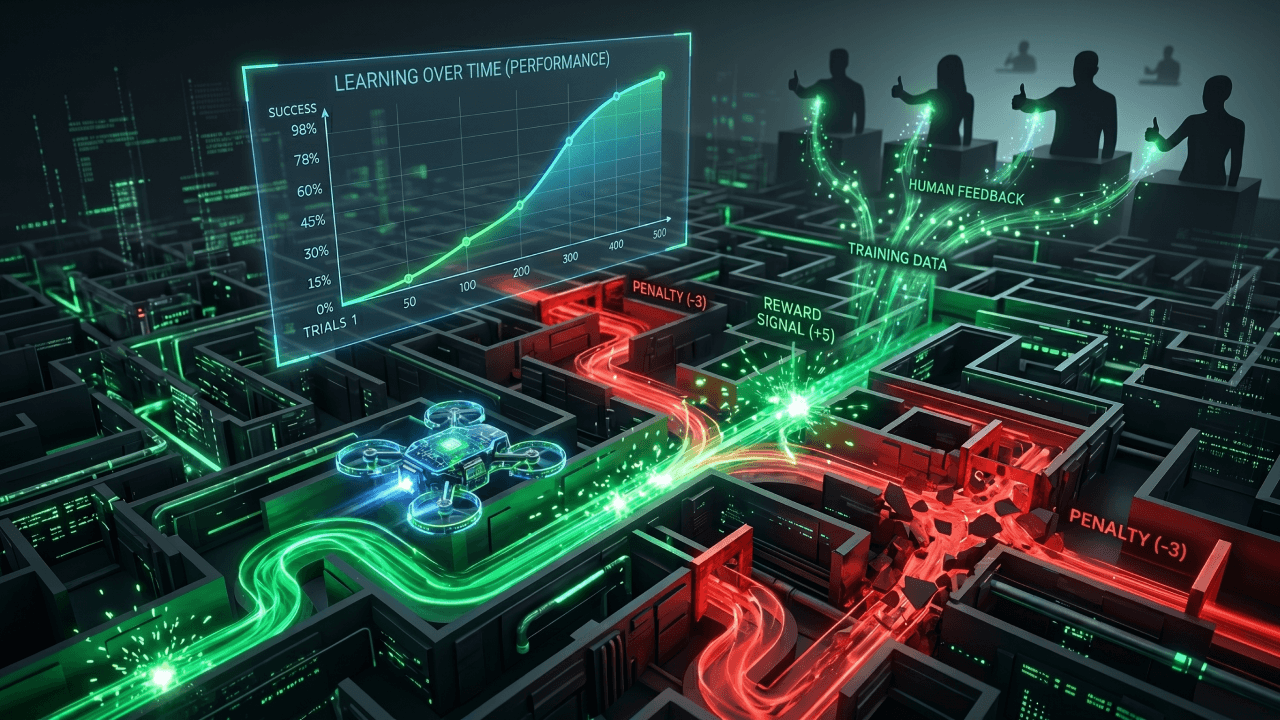
Legacy dispatch systems built on straight-line distance calculations are losing market share fast. The platforms eating their lunch share one thing: an AI layer that predicts demand before it surfaces, matches drivers to riders in ways that reduce total fleet idle time — not just the single nearest trip — and adapts its UI to each user’s behavior. If you are planning to build an AI-powered on-demand app for taxi, delivery, or healthcare scheduling, the architectural decisions you make in the first sprint will determine whether your platform can compete or whether you are rewriting the core engine 18 months from now.
- AI-powered dispatch uses Reinforcement Learning (RL) to minimize fleet-wide idle time, not just the nearest match — this is the core differentiator versus legacy systems.
- Predictive demand forecasting reads weather, local events, and transit schedules to reposition drivers before demand spikes, eliminating supply bottlenecks proactively.
- The production tech stack centers on Flutter or React Native for mobile, Node.js or Ruby on Rails for the backend, and a PyTorch or scikit-learn pipeline for the AI models.
- An MVP with core AI matching runs $20,000–$35,000; a full-scale platform with RL fleet management and dynamic pricing starts at $40,000–$50,000+.
- Tecorb’s RL-optimized taxi booking admin dashboard cut average user wait times by over 22% — the same pattern applies across delivery and healthcare scheduling verticals.
Why the Traditional On-Demand Model Is Broken
Most first-generation on-demand apps solve a simple assignment problem: find the nearest available driver and send them. That logic works until your platform grows. At scale, “nearest driver” creates clustering effects — all idle drivers gravitate toward the same high-demand zones while adjacent areas go unserved. Surge pricing arrives too late because the system reacts rather than anticipates.
The outcome is predictable: longer waits, lower driver earnings per hour, and churn from both sides of the marketplace. Real-time geo-matching solves for one trip. AI solves for the entire fleet.
The Anatomy of an AI-Driven On-Demand Platform
An intelligent on-demand ecosystem goes far beyond maps and payment gateways. The modern architecture relies on three interdependent predictive engines that run behind every user interaction.
[User Request] ──> [AI Predictive Matching Engine] <── [Real-Time Driver Telemetry]
                             │
                             ├──> [Reinforcement Learning Route Optimization]
                             │
                             └──> [Dynamic Pricing Engine (Surge Model)]
Each engine feeds the others. The matching engine needs real-time telemetry to place drivers accurately. The RL optimizer needs historical match data to improve its policy. The pricing engine needs demand forecast data from both to calibrate surge multipliers without destroying conversion rates.
Reinforcement Learning for fleet optimization
Instead of assigning a job to the closest driver in a straight line, next-generation platforms use Reinforcement Learning (RL) models trained on historical traffic patterns, driver behavior, and incoming demand blocks. The RL agent learns a policy that minimizes the entire fleet’s collective idle time — not just the outcome of a single trip assignment. Over time, the model learns that pre-positioning three drivers in a lower-demand zone at 7:45 AM prevents a supply gap when a nearby train arrives at 8:00 AM.
This is the core technical differentiation between a first-generation on-demand app and a competitive platform. Research published in Transportation Science confirms that RL-based dispatching outperforms distance-based heuristics across all fleet utilization metrics in high-density urban environments.
Predictive demand forecasting
The demand forecaster ingests historical booking data alongside external signals: weather patterns, concert and sporting event schedules, flight and train arrivals, and local public holidays. The model flags high-demand zones before supply gaps form, prompting drivers to relocate proactively. The practical result is smoother surge behavior and higher gross merchandise value per hour — drivers spend less time repositioning after the fact.
Insight: Demand forecasting models trained on fewer than 90 days of platform data tend to overfit to early usage patterns. Plan for a 3-month data collection phase before your forecaster reaches production-grade accuracy.
Hyper-personalized UX and contextual intent detection
Modern platforms adapt dynamically to individual user behavior. If a passenger books a ride to the same office at 8:45 AM on weekdays, the platform’s contextual intent layer surfaces that trip as a one-tap option on the home screen — before the user opens the search field. This is not a superficial UX polish. It directly reduces booking abandonment and increases session-to-order conversion rates.
For healthcare scheduling apps, the same logic applies differently: the system learns appointment cadence, preferred providers, and commute windows to pre-populate scheduling options that the patient is most likely to accept.
How the Same Architecture Applies Across Three Verticals
The AI matching and prediction layer described above is not taxi-specific. The underlying patterns apply across the three most active on-demand verticals — with domain-specific adaptations.
Taxi and ride-sharing
The primary optimization target is wait time and driver utilization rate. RL-based dispatch is the highest-leverage AI investment here. Dynamic pricing engines handle the revenue side. The Tecorb team’s RL-optimized taxi booking admin dashboard reduced average user wait times by over 22% in production — achieved by training the matching model on 6 months of trip data and incorporating real-time traffic telemetry from the map layer.
On-demand delivery
Delivery platforms add route sequencing complexity — a driver may carry multiple concurrent orders with different delivery windows. The AI layer here handles multi-stop route optimization and real-time re-routing when traffic or customer unavailability changes the sequence mid-run. Estimated time of arrival (ETA) accuracy is the key product metric; ML-based ETA models trained on actual delivery data significantly outperform static map-API estimates.
Healthcare scheduling
Healthcare introduces compliance constraints that taxi and delivery do not have. An AI scheduling assistant must respect provider licensing scope, appointment duration variability, insurance network rules, and patient-specific preferences. The matching problem is more constrained, but the underlying pattern — predict demand, pre-populate likely options, reduce friction at the booking step — is identical.
Pro tip: If you are building across more than one vertical, design the core matching engine as a domain-agnostic service with constraint plugins per vertical. This avoids maintaining three separate dispatch codebases.
The Ideal Tech Stack for an AI-Powered On-Demand App
To build a platform capable of handling intense, real-time data calculations without lag, the technical foundation must be chosen for production load, not just prototype speed.
| Layer | Recommended Options | Why |
|---|---|---|
| Mobile frontend | Flutter, React Native, Hotwire Native | Flutter for pixel-perfect cross-platform; React Native for large JavaScript team reuse; Hotwire Native for web-forward, ultra-lean setups |
| Backend | Node.js, Ruby on Rails | Node.js handles concurrent WebSocket connections (driver telemetry) efficiently; Rails offers rapid API development with modern multi-threaded tooling |
| AI pipeline | PyTorch, scikit-learn, LangChain | PyTorch for custom RL model training; scikit-learn for forecasting tasks; LangChain for contextual intent and conversational interfaces |
| Data tier | PostgreSQL with PGvector, Redis | PGvector enables fast spatial queries without a separate geo-database; Redis caches real-time driver location telemetry at sub-millisecond latency |
| Infrastructure | AWS, GCP, or Azure with Kubernetes | Autoscaling is non-negotiable for demand spikes at events or peak hours |
On the mobile choice: Flutter and React Native both ship production-quality apps. The deciding factor is usually your team composition. If your engineers write JavaScript, React Native shortens the ramp. If you are starting fresh or want tighter native performance controls, Flutter’s Dart layer is worth the learning curve. Hotwire Native is worth evaluating only if your product logic lives primarily in a server-rendered web layer.
On the AI pipeline: PyTorch is the standard for custom RL model development. scikit-learn handles most tabular prediction tasks — demand forecasting, ETA models — without the overhead of deep learning infrastructure. LangChain becomes relevant when your app includes conversational interfaces: in-app support agents, healthcare intake flows, or natural-language trip planning.
What Does It Actually Cost to Build an AI-Powered On-Demand App?
Cost scales with feature depth, AI complexity, and the number of platforms targeted. The figures below reflect Tecorb’s project experience — not generic industry averages.
MVP scope: $20,000 – $35,000
Core ride-matching or delivery assignment logic with basic AI matching. Single mobile platform (iOS or Android) plus a lightweight admin dashboard. No RL optimization at this stage — matching is ML-assisted but rule-bounded. Suitable for validating product-market fit before investing in the full AI stack.
Typical timeline: 12–16 weeks.
Advanced scale: $40,000 – $50,000+
Full RL fleet management with trained dispatch policy. Dynamic pricing engine with surge modeling. Cross-platform mobile (iOS + Android). Real-time driver telemetry pipeline. Demand forecasting model with external data integrations (weather, events). Multi-role admin panel with analytics.
Typical timeline: 20–28 weeks depending on data infrastructure readiness.
What drives cost above $50,000? The primary drivers are data infrastructure complexity (proprietary map layers, third-party event APIs, compliance data stores for healthcare), multi-region deployment, and extended model training cycles when historical data is sparse.
Warning: AI model training costs are recurring, not one-time. Budget for ongoing retraining as your platform accumulates new behavioral data — models trained on launch-month data degrade as user patterns evolve. Set aside 10–15% of initial AI build cost annually for model maintenance.
Key Features to Include at Each Build Stage
Not every feature belongs in the MVP. Shipping unnecessary complexity in the first version delays market validation and inflates cost. Here is a prioritized feature map.
Must-have at MVP
- Real-time driver and rider geo-tracking
- AI-assisted job matching (ML model, not raw distance)
- Estimated time of arrival with map integration
- In-app payment processing
- Rating and review system
- Push notifications for booking status
- Admin dashboard: live map, trip management, basic analytics
Add at growth stage
- Reinforcement Learning dispatch policy (requires 60–90 days of booking data minimum)
- Predictive demand heatmaps for drivers
- Dynamic pricing engine
- One-tap contextual booking from user behavior history
- Multi-stop route optimization (delivery verticals)
- In-app chat or AI-powered support agent
Add at scale stage
- Multi-city and multi-region fleet management
- Predictive maintenance alerts (vehicle telematics integration)
- LLM-powered conversational booking interface
- Healthcare-specific: provider licensing validation, insurance network matching
How AI Changes the Unit Economics
The business case for AI in on-demand apps is not speculative. The unit economics shift in measurable ways once the AI layer reaches production quality.
Driver utilization rate increases when RL dispatch pre-positions supply. Idle time drops. Drivers complete more trips per shift without working longer hours — which reduces churn on the supply side.
Gross margin per trip improves when dynamic pricing operates on real forecasts rather than reactive surge triggers. Surge events that happen too early (when supply is still adequate) damage conversion; events that activate too late leave revenue on the table. Forecast-driven pricing captures the middle.
Customer lifetime value rises when contextual UX reduces booking friction. A user who can confirm their regular commute in one tap books more often and churns less.
The 22% wait time reduction Tecorb achieved on the RL-optimized taxi booking admin dashboard is one data point — but it is consistent with the broader research literature on RL-based dispatch, where gains of 15–30% on wait time are typical once the model has sufficient training data.
Common Mistakes That Derail AI-Powered On-Demand Builds
Choosing AI infrastructure before understanding the data problem. An RL dispatch model requires clean, labeled historical trip data to train on. If your platform is new, you do not have that data yet. Launching with a well-tuned ML matching model and collecting the trip data you need is the right sequence — not the reverse.
Building platform-specific AI models for each vertical. If your product roadmap includes taxi, delivery, and healthcare, the temptation is to build separate AI systems. The smarter path is a shared matching engine with domain-specific constraint layers. It costs more to design upfront and significantly less to maintain.
Underestimating real-time infrastructure cost. Processing driver telemetry at one-second intervals for a fleet of 500 drivers generates non-trivial data volume. Redis caching, WebSocket connection management, and database write throughput all need to be sized for peak load, not average load.
Skipping the admin intelligence layer. Operators need visibility into what the AI is doing and why. A dispatch model that produces good outcomes but cannot explain its decisions to your ops team will face internal resistance. Build explainability into the admin dashboard from the start.
Frequently Asked Questions
How long does it take to build an AI-powered on-demand app?
An MVP with AI-assisted matching typically takes 12–16 weeks with a focused team. A full-scale platform including RL dispatch, dynamic pricing, and demand forecasting runs 20–28 weeks. Timeline variability comes primarily from data infrastructure readiness and the number of third-party API integrations required.
What is the minimum viable dataset needed to train an AI dispatch model?
Most RL dispatch models require at minimum 60–90 days of real trip data before the policy outperforms a well-tuned rule-based baseline. During the MVP phase, use a supervised ML matching model trained on synthetic or partner data, and collect the production data needed for RL training before the next build cycle.
How does reinforcement learning differ from standard matching algorithms in dispatch?
Standard matching algorithms solve for the locally optimal assignment — closest driver, fastest ETA. Reinforcement Learning solves for a globally optimal policy: it learns, over time, that decisions now affect fleet distribution 10–20 minutes later. This horizon-aware optimization is why RL dispatch consistently outperforms heuristic systems on fleet-wide metrics at scale.
Can the same AI architecture work for both taxi and delivery apps?
Yes. The core matching and demand forecasting engines are domain-agnostic. Delivery adds multi-stop route sequencing and package state tracking. The AI layer needs to handle constraint sets — delivery windows, capacity limits — that ride-sharing does not. Designing the matching engine as a shared service with pluggable constraint modules is the recommended architecture if you plan to serve both verticals.
What ongoing costs should I budget for after launch?
Beyond standard cloud and support costs, AI-specific ongoing costs include model retraining (as user behavior evolves), data pipeline maintenance, and model monitoring infrastructure. Budget approximately 10–15% of the initial AI build cost annually for model operations. For a $40,000 build, that is $4,000–$6,000 per year for model health.
Is Flutter or React Native better for an on-demand app?
Both are production-proven for on-demand platforms. React Native is the pragmatic choice if your engineering team already writes JavaScript. Flutter offers tighter performance control and a more consistent cross-platform rendering model, which matters for real-time map interactions. The choice rarely determines success — team familiarity does.
How does AI improve healthcare on-demand scheduling differently than taxi dispatch?
Healthcare scheduling has hard constraints that taxi dispatch does not: provider licensing scope, appointment duration variability, insurance network restrictions, and clinical care continuity rules. The AI layer’s job in healthcare is not pure speed optimization — it is constraint-aware matching that surfaces the highest-quality, most convenient options within a defined rule set. The demand forecasting component is still valuable: predicting appointment no-shows and pre-filling cancellation slots is a direct revenue benefit.
Build Your AI-Powered On-Demand Platform with Tecorb
Tecorb’s engineering team has built production AI dispatch systems across taxi booking, delivery logistics, and healthcare scheduling. Our RL-optimized taxi admin dashboard cut average wait times by over 22% in production. We bring the same AI pipeline architecture — PyTorch-trained dispatch models, real-time telemetry infrastructure, and predictive demand forecasting — to every on-demand platform we build.
Whether you are validating an MVP at the $20,000–$35,000 range or engineering a full-scale platform with RL fleet management, our team can scope, design, and ship it.
Book a 30-minute architecture call with Tecorb’s on-demand app team.
Already have a spec? See our mobile and on-demand app development portfolio to review systems we have shipped.