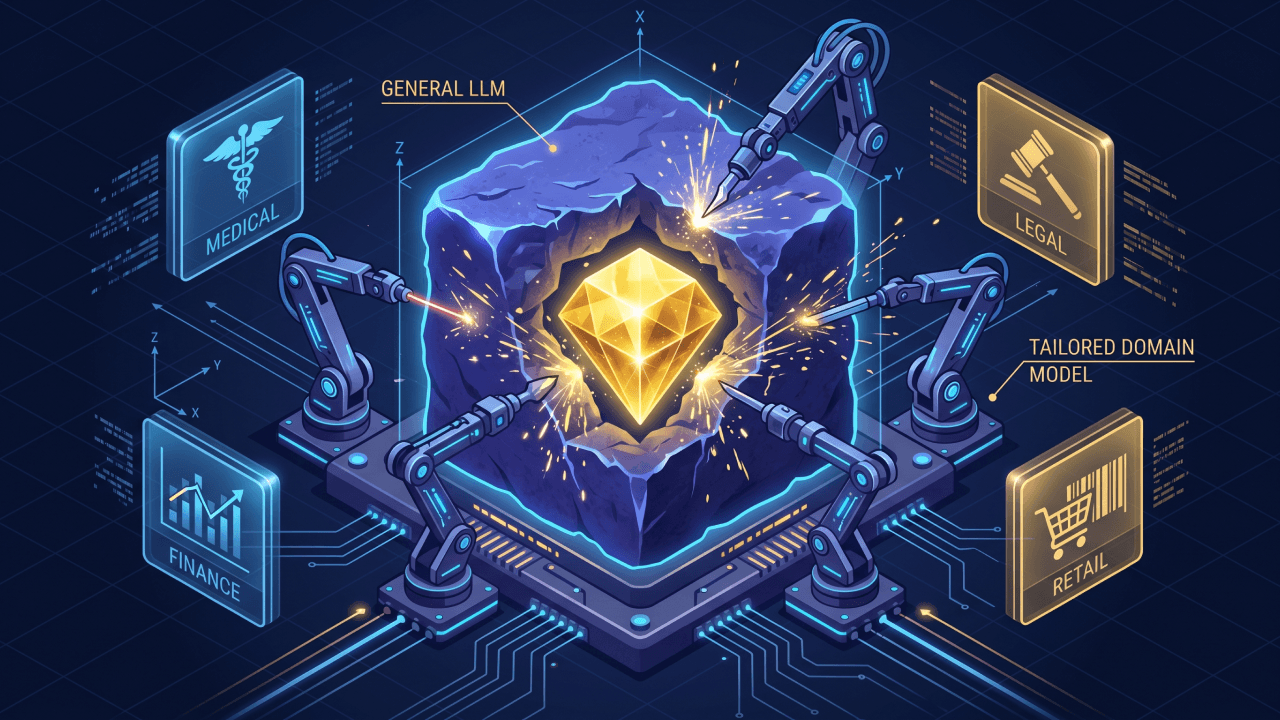
Why Enterprise Leaders Are Swapping LLMs for SLMs
Deploying a massive foundational model for a narrow corporate task is like hiring a world-class philosopher to balance your corporate spreadsheets. It is overkill, and it is expensive.
For specific business domains — clinical medical documentation, algorithmic logistics routing, legal contract review — a fine-tuned, highly specialized SLM consistently outperforms a massive general-purpose model on domain accuracy while running at a fraction of the compute cost. This is not a future prediction; enterprise teams that initially integrated frontier LLMs via API are now rebuilding parts of that stack around fine-tuned SLMs, driven by cost pressure, data governance requirements, and the need for sub-100ms latency on high-volume workflows.
The shift is structural, not cyclical.
| Metric / Feature | Foundational LLMs (Public APIs) | Fine-Tuned SLMs (On-Prem / Private Cloud) |
|---|---|---|
| Data Privacy and Compliance | High risk; data often leaves your secure perimeter | 100% contained; runs entirely within your isolated cloud (AWS/Azure) |
| Latency and Speed | Subject to public server traffic and network delays | Ultra-low latency; optimized for real-time enterprise workflows |
| Operational Cost | Token-based pricing scales aggressively with usage | Flat infrastructure costs; predictable at any query volume |
| Domain Accuracy | High risk of generic hallucinations outside the model’s training mix | Highly specialized; trained on your corporate terminology and workflows |
| Compliance Control | Vendor-dependent; audit trail is opaque | Full observability; logs, weights, and outputs stay on your infrastructure |
Insight: A fine-tuned 7B model served on-premises can reduce per-token cost by 10-30x compared to frontier API pricing at production scale — and removes per-call latency from the equation entirely. The break-even point typically arrives within six months of deployment for workloads exceeding 10,000 daily queries.
What Qualifies as a Small Language Model?
Small Language Models are transformer-based language models with parameter counts typically ranging from 1B to 13B. Unlike frontier models (GPT-4, Claude 3, Gemini Ultra) trained on tens of billions of parameters across general-purpose corpora, SLMs are designed for efficiency: they run on a single GPU, fit in edge deployment environments, and respond to fine-tuning with far fewer training examples than their larger counterparts.
The leading enterprise SLMs as of mid-2026 are:
- Llama 3 (8B) — Meta’s open-weight model; strong instruction-following baseline, widely supported across the fine-tuning toolchain
- Phi-3 (3.8B) — Microsoft’s compact model; punches significantly above its parameter weight on reasoning tasks
- Mistral 7B — Best open-weight model for custom fine-tuning; sliding-window attention makes it efficient on long-context enterprise documents
- Gemma 2 (9B) — Google’s open model; strong performance on structured output tasks like SQL generation and JSON extraction
- Qwen 2.5 — Alibaba’s multilingual SLM; relevant for global enterprises operating across Asian markets
Choosing the right base model matters as much as the fine-tuning strategy. A base model with strong instruction-following capability requires fewer training examples to specialize, which reduces your data curation burden significantly.
The 4-Step Technical Architecture for Enterprise SLM Fine-Tuning
Building an enterprise-grade specialized AI agent requires a systematic approach to data engineering and model training. Skipping steps — particularly alignment — produces models that are accurate in the lab but unreliable in production.
Step 1: Data curation and synthetic data expansion
Your fine-tuning is only as good as your training data. The process begins by extracting raw corporate documents — logs, contracts, support tickets, database schemas — and parsing them into clean instruction-response pairs.
Quality beats quantity at every stage. Research from Microsoft’s enterprise search team demonstrates that fine-tuned SLMs trained on carefully curated synthetic data can achieve a 17x increase in throughput and 19x improvement in cost-efficiency compared to frontier models on labeling tasks — but only when the training data is rigorously validated, not scraped en masse.
If raw enterprise datasets are sparse, synthetic data generation using transformer architectures can bridge the gap without exposing real user data. Generate synthetic queries from seed documents, retrieve hard negatives via BM25, and validate the pairs against your domain ground truth before they enter the training pipeline.
Watch out: Training on uncleaned corporate data — support tickets with inconsistent formatting, contracts with legacy clause structures — propagates noise directly into model behavior. Budget one-third of your fine-tuning timeline for data validation. Teams that skip this step spend twice as long debugging production failures.
Step 2: Supervised Fine-Tuning (SFT) with LoRA and QLoRA
During SFT, the base SLM trains on your curated instruction-response dataset. Full-parameter fine-tuning is possible but rarely necessary. Two parameter-efficient techniques dominate enterprise deployments:
LoRA (Low-Rank Adaptation): Freezes the majority of the model’s weights and injects small trainable rank-decomposition matrices into the attention layers. A 7B model fine-tuned with LoRA typically updates fewer than 1% of total parameters while achieving task-specific performance comparable to full fine-tuning.
QLoRA: Combines LoRA with 4-bit quantization, reducing the GPU memory footprint dramatically. A Mistral 7B model can be fine-tuned via QLoRA on a single 12 GB consumer GPU — a significant accessibility improvement over earlier fine-tuning approaches that required eight 80 GB A100s.
The Unsloth framework has further consolidated QLoRA workflows, enabling teams without dedicated ML infrastructure engineers to run complete fine-tuning pipelines on modest hardware budgets.
Step 3: Alignment engineering — DPO vs. RLHF
A supervised fine-tuned model knows how to perform your task. An aligned model knows how to perform your task while respecting compliance constraints, security guidelines, and the tone your organization requires. This distinction is not cosmetic — misaligned enterprise models produce outputs that are accurate but inappropriate, creating legal and reputational exposure.
Two alignment methods matter in practice:
RLHF (Reinforcement Learning from Human Feedback): Collects human preference rankings across model outputs, trains a secondary reward model to score those preferences, then uses reinforcement learning to optimize the base model against that reward signal. RLHF produces high-quality alignment but introduces significant operational complexity: multiple models to maintain, tricky RL hyperparameter search, and substantial compute overhead.
DPO (Direct Preference Optimization): A streamlined approach that mathematically optimizes the model directly on paired preference data (preferred response vs. rejected response) without training a separate reward model. DPO has displaced RLHF as the default choice for most production alignment teams in 2025-2026. It is cheaper, more stable to train, and produces comparable alignment quality for narrow domain tasks.
For most enterprise use cases — domain Q&A, contract review, internal tooling — DPO is the correct default. Reserve RLHF for situations where alignment quality is genuinely critical and your team has the ML research capacity to maintain it.
Pro tip: Before committing to either alignment method, validate whether your task actually requires alignment engineering or whether your SFT dataset quality is sufficient. A clean, representative training set often produces adequately aligned outputs for internal tooling without an explicit alignment pass.
Step 4: The RAG hybrid architecture
Fine-tuning teaches your model how to speak and behave in your domain. It does not give the model access to information that changes after training — and that distinction is where most enterprise architectures break down.
Retrieval-Augmented Generation (RAG) provides the model with a real-time, searchable knowledge base. By connecting your fine-tuned SLM to a vector database — Pinecone, PGvector, or Weaviate are the most common choices in enterprise deployments — the model can retrieve live information from your document store at inference time while maintaining its tailored domain expertise.
The roles are distinct and should be designed that way:
- Fine-tuning handles style, tone, domain logic, output format, and compliance behavior
- RAG handles live information retrieval — product inventory, recent policy documents, current customer records
Conflating these roles produces systems that are simultaneously over-engineered (fine-tuning on volatile data) and under-equipped (no retrieval layer for live queries). Design the division before you write a line of training code.
Insight: Never use fine-tuning alone to teach a model volatile data that changes daily — live inventory, user metrics, or pricing tables. Use fine-tuning for style, tone, and domain logic; use RAG for real-time information retrieval. This single architectural decision prevents the most common class of enterprise AI failures.
When to Fine-Tune vs. When to Use RAG Alone
Not every enterprise AI use case requires fine-tuning. Understanding where fine-tuning genuinely adds value — and where it does not — prevents wasted compute budgets and over-engineered systems.
| Situation | Recommended approach |
|---|---|
| Company-specific terminology the base model does not know | Fine-tuning (SFT) |
| Consistent output format (JSON, specific report structure) | Fine-tuning (SFT) |
| Compliance-aligned tone and refusal behavior | Fine-tuning + DPO alignment |
| Access to live or frequently updated documents | RAG only |
| General Q&A over a static document corpus | RAG only |
| High-volume, narrow, repeatable task (contract clause extraction) | Fine-tuning + RAG |
| Broad general assistant use case | Prompt engineering first; fine-tune only after clear failure |
A practical rule from production teams: try RAG and better prompt engineering before committing to fine-tuning. Roughly 80% of “we need fine-tuning” requests are resolved by improving retrieval quality or prompt structure. Fine-tuning is the right answer — just not always the first answer.
What Does It Cost to Fine-Tune and Deploy an SLM?
Enterprise teams consistently underestimate the total cost of fine-tuning because they focus on training compute and ignore the full lifecycle cost.
Training compute: Fine-tuning a 7B model via QLoRA on a cloud GPU instance costs roughly $13-$50 per training run depending on dataset size and cloud provider. Full fine-tuning without LoRA on a 7B model requires eight 80 GB GPUs and can run $500-$2,000 per training cycle.
Inference infrastructure: Running a 7B model on a bare-metal server with L40S GPUs costs approximately $953/month for self-managed deployment. Managed inference via a cloud provider typically runs $500-$2,000/month for a model serving 10,000 daily queries.
Comparison to LLM API costs: Frontier LLM APIs charge $2-$30 per million tokens depending on the model. At 10,000 daily queries averaging 500 tokens each, that is $5,000-$50,000/month. A privately hosted fine-tuned SLM serving the same volume runs $500-$2,000/month — a 5-20x cost reduction, with the break-even on fine-tuning investment typically landing within six months.
Hidden costs to budget for: Data curation and labeling (often the largest cost), MLOps tooling, model evaluation infrastructure, and ongoing fine-tuning cycles as your domain data evolves.
Watch out: The economics of SLM fine-tuning favor high-volume, narrow, repeatable tasks. If your use case is low-volume or highly general, the operational overhead of maintaining a fine-tuned model may outweigh the API cost savings. Model the break-even before committing.
Common Pitfalls in Enterprise SLM Deployments
Understanding where teams fail helps you design past the failure modes before you hit them.
Training on uncleaned data. Corporate document archives contain formatting inconsistencies, legacy structures, and noise that propagates directly into model behavior. One bad data pattern repeated across 500 training examples becomes a reliable model failure.
Skipping evaluation before deployment. Domain-specific models require domain-specific evaluation benchmarks. Generic benchmarks like MMLU or HellaSwag do not measure performance on your contract clauses or your support ticket vocabulary. Build evaluation datasets from real production examples before fine-tuning begins.
Using fine-tuning to solve a retrieval problem. If the issue is that the model does not have access to current information, fine-tuning will not fix it. Build the RAG layer first.
One-shot fine-tuning with no refresh cycle. Enterprise domains evolve. A fine-tuned model trained on last year’s compliance guidelines will drift from current requirements within months. Build a re-fine-tuning cadence into your MLOps plan from day one.
No safety evaluation after alignment. DPO alignment reduces unwanted behavior, but it does not eliminate it. Run red-team evaluations on aligned models before exposing them to production traffic.
Building the MLOps Layer for Ongoing SLM Management
A fine-tuned SLM is not a one-time artifact; it is a managed system with a lifecycle.
The minimum viable MLOps stack for an enterprise SLM deployment includes:
- Experiment tracking: MLflow or Weights and Biases for logging training runs, hyperparameters, and evaluation metrics
- Model registry: A versioned store (MLflow Model Registry, Hugging Face Hub private repo) for model artifacts and promotion workflows
- Serving infrastructure: vLLM or TGI (Text Generation Inference) for high-throughput SLM serving; both support LoRA adapter hot-swapping, which means you can update a fine-tuned adapter without restarting the base model server
- Monitoring: Token-level latency, output quality metrics (domain-specific), and drift detection on input distribution
- Re-fine-tuning pipeline: Automated data ingestion from production feedback, periodic SFT refresh, automated regression testing before promotion
Teams that build the MLOps layer after the model are usually the teams rebuilding the entire stack six months later.
Pro tip: vLLM’s LoRA adapter hot-swapping feature is underused in enterprise deployments. It allows you to serve multiple fine-tuned variants (different departments, different compliance regimes) from a single base model instance, dramatically reducing infrastructure overhead when managing more than one specialized model.
Frequently Asked Questions
What is the difference between fine-tuning and RAG for enterprise AI?
Fine-tuning modifies a model’s weights using your proprietary training data, teaching it your domain’s language, output format, and compliance behavior. RAG (Retrieval-Augmented Generation) leaves the model weights unchanged and instead provides real-time access to a searchable document store at inference time. Most production enterprise systems use both: fine-tuning for domain specialization, RAG for live information retrieval.
Which SLMs work best for enterprise fine-tuning in 2026?
Mistral 7B remains the strongest open-weight model for custom fine-tuning due to its efficient architecture and broad toolchain support. Llama 3 (8B) offers excellent instruction-following baselines and is widely supported. Phi-3 (3.8B) is the top choice for constrained deployment environments where GPU memory is limited. The right base model depends on your task, hardware budget, and whether multilingual capability is required.
How much data do I need to fine-tune a small language model?
Quality matters more than quantity. For narrow domain tasks, 500-2,000 high-quality instruction-response pairs often produce strong results via LoRA or QLoRA. Poorly curated datasets of 50,000 examples typically underperform clean datasets of 2,000. If your enterprise data is sparse, synthetic data generation from seed documents is a validated approach — Microsoft Research demonstrated that SLMs trained on high-quality synthetic data match frontier LLM performance on enterprise search labeling tasks.
Is DPO or RLHF better for aligning an enterprise AI model?
DPO (Direct Preference Optimization) is the practical default for most enterprise teams in 2026. It requires no reward model, is cheaper to run, and produces alignment quality comparable to RLHF for narrow domain tasks. RLHF is worth considering only when your alignment requirements are complex, your team has dedicated ML research capacity, and the task demands the highest possible preference fidelity. For internal tooling, contract review, and domain Q&A, DPO is sufficient.
Can I fine-tune a small language model without a large GPU cluster?
Yes. QLoRA enables fine-tuning of 7B-8B parameter models on a single 12 GB consumer GPU. The Unsloth framework further reduces memory overhead, making fine-tuning accessible without cloud GPU budgets. That said, production-quality fine-tuning at enterprise scale — with validation, evaluation, and re-training cycles — still benefits from cloud GPU access for faster iteration. The barrier is lower than it was; it is not zero.
How do I keep a fine-tuned model compliant as regulations change?
Build re-fine-tuning into your MLOps cadence from the start. Compliance-aligned behavior is encoded in your DPO training data; when regulations change, your preference pairs change too. Treat the fine-tuned model as a managed artifact with a version history rather than a static deployment. Additionally, pair the model with a RAG layer over your current compliance document library so the model can surface the latest guidance even between re-fine-tuning cycles.
What are the data privacy risks of fine-tuning with proprietary enterprise data?
When fine-tuning on-premises or in a private cloud, your training data never leaves your infrastructure. The primary risk is data memorization: models fine-tuned on sensitive data can sometimes reproduce verbatim training examples in their outputs. Mitigate this with differential privacy techniques during training, output filtering in production, and evaluations specifically designed to detect memorization of PII or confidential records. Avoid fine-tuning on personally identifiable information unless your privacy infrastructure explicitly accounts for memorization risk.
Build Your Enterprise SLM — With a Team That Has Shipped This in Production
Fine-tuning an SLM for enterprise use is a systems engineering problem, not just an ML problem. The data pipeline, the alignment pass, the RAG integration, the MLOps layer, and the evaluation infrastructure all have to work together before the model delivers reliable business value.
Tecorb’s AI and ML engineering team has built fine-tuned domain models for production use cases across logistics, healthcare, and enterprise search — using the exact architecture described in this guide. If you are evaluating whether a fine-tuned SLM is the right move for your organization, or if you have already decided and need an experienced team to build and maintain the stack, we can help.