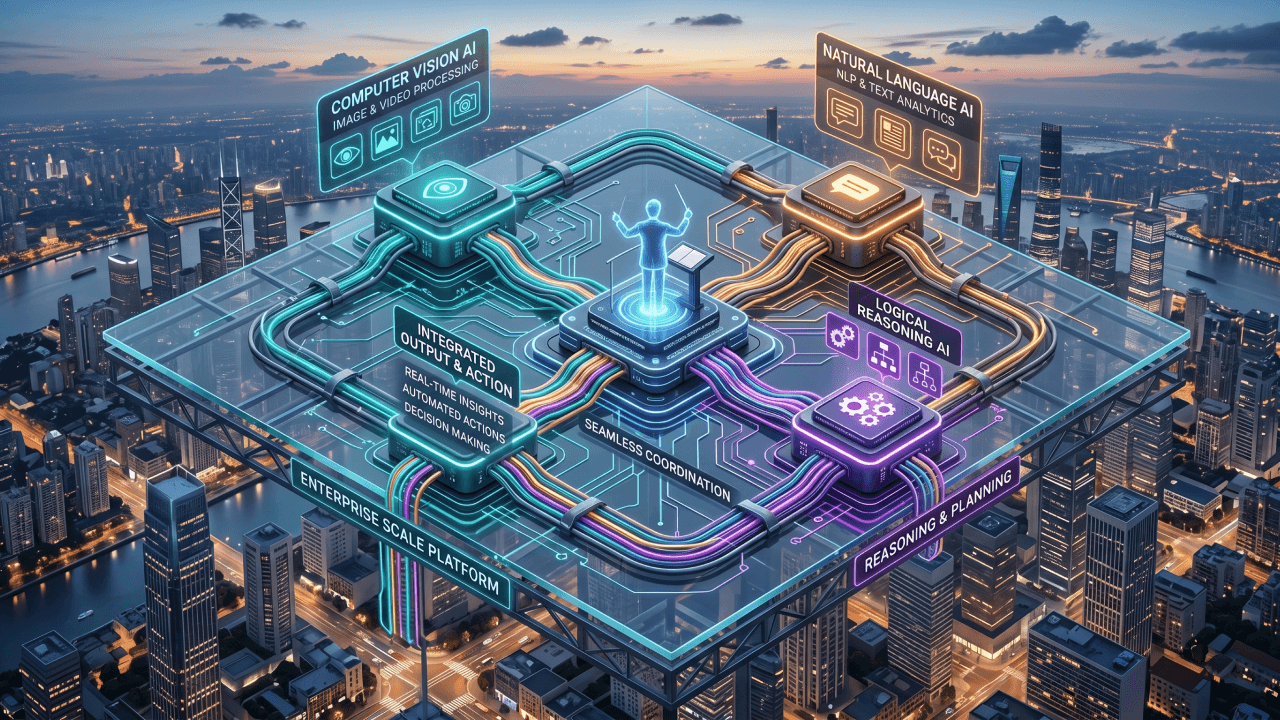
The era of the single-prompt AI chatbot is over. While basic generative AI wrappers can draft a decent email or field a customer service FAQ, they fundamentally fail against complex, multi-layered corporate operations. They lack persistent memory, they cannot self-correct, and they cannot autonomously collaborate with other software systems. According to a 2025 Gartner forecast, 40% of enterprise applications will embed task-specific AI agents by the end of 2026 — up from fewer than 5% in 2024. The teams deploying those agents are not building smarter chatbots. They are building multi-agent AI systems: coordinated networks of specialized, autonomous agents that execute end-to-end business workflows without human hand-holding at every step.
This guide covers how to architect, orchestrate, and safely deploy a multi-agent AI system at enterprise scale — from picking the right orchestration framework to enforcing the cost controls that keep token bills from spiraling into six figures.
Single LLM vs. RAG vs. Multi-Agent Systems: What Actually Differs
Understanding why multi-agent architecture matters requires a clear-eyed look at how each approach handles complexity.
| Capability | Single LLM Prompt | Classic RAG Architecture | Multi-Agent Ecosystem |
|---|---|---|---|
| Primary function | Static text generation | Knowledge retrieval + answering | Autonomous goal execution |
| Context handling | Limited to immediate prompt | High semantic context retrieval | Persistent long-term memory and history |
| Tool execution | None | Limited (reads specific data) | Full API access — writes code, triggers systems |
| Self-correction | Outputs first guess | Evaluates answers against data source | Loops and self-critiques until accurate |
| Failure mode | Silent hallucination | Incorrect retrieval | Infinite loop or cascading agent failure (mitigated by circuit-breakers) |
A single LLM is a brilliant generalist who can only hold one thought at a time. Retrieval-Augmented Generation (RAG) gives that generalist access to a library. A multi-agent system gives you a coordinated team — each member with a defined role, the right tools for that role, and the ability to hand work off when their part is done.
Insight: The shift from RAG to multi-agent is not primarily a quality upgrade — it is a scope upgrade. RAG answers questions. Multi-agent systems execute processes.
The Blueprint: Architecting a Multi-Agent Financial Audit Loop
To see how these systems work in practice, consider an autonomous Financial Auditing and Risk Assessment system. A human traditionally opens five software tools across two hours. The multi-agent version handles the entire workflow natively.
[User Request: Run Q3 Compliance Audit]
                   |
                   v
      +---------------------------+
      |   1. Supervisor Agent    |<-- (Regulates and assigns)
      +---------------------------+
           /         |          \
          v          v           v
+------------------+ +------------------+ +------------------+
| 2. Invoicing     | | 3. Compliance    | | 4. Reporter      |
|    Agent         | |    Agent         | |    Agent         |
| (Scrapes         | | (Checks IRS      | | (Generates PDF   |
|  QuickBooks)     | |  Standards)      | |  / Alerts)       |
+------------------+ +------------------+ +------------------+
Supervisor Agent — Receives the high-level objective, decomposes it into sequential sub-tasks, and delegates them to specialist agents.
Invoicing Agent — Authenticates via secure APIs into the enterprise ERP, extracts Q3 transaction history, and flags anomalies.
Compliance Agent — Takes those anomalies, cross-references them against active tax regulations using a vector database, and calculates risk scores.
Reporter Agent — Compiles findings into an executive PDF brief, drafts a Slack summary for the CFO, and queues the system for final human sign-off.
Each agent holds a narrow, clearly bounded role. No single agent needs to know how to do everything — it only needs to do its part reliably and hand off cleanly.
Watch out: The most common architecture mistake is building agents that are too broad. An agent tasked with “handle all financial data” is a single point of failure. An agent tasked with “extract anomalies from QuickBooks API and return a structured JSON” is testable, replaceable, and auditable.
How to Choose the Right Orchestration Framework
Building this architecture requires an orchestration layer that manages state, memory, and routing between nodes. Two frameworks dominate enterprise production deployments in 2026: LangGraph and CrewAI.
LangGraph vs. CrewAI
CrewAI is built on a role-playing model. You define agents with named roles, goals, and tool access — then CrewAI handles how they collaborate. It is highly abstract, production-ready out of the box, and ideal for workflows that map cleanly to human organizational structures (a Content Creator agent talking to an Editor agent, for example). Teams can ship working multi-agent pipelines in days, not weeks.
LangGraph is built on top of LangChain and models workflows as stateful graphs — nodes and edges that you define explicitly. This gives absolute control over cyclical loops. An agent can say, in effect, “This output doesn’t meet the quality threshold; route this back to the data-extraction node and retry.” LangGraph is more verbose, but it is the right choice for production systems that need conditional branching, human-in-the-loop validation at specific steps, or complex recovery logic.
| Dimension | CrewAI | LangGraph |
|---|---|---|
| Learning curve | Low — role + task abstraction | Medium — graph model requires design upfront |
| Control granularity | Medium | High |
| Best for | Content pipelines, CRM automation, structured workflows | Financial systems, compliance, any workflow requiring audit trails or loop control |
| Human-in-the-loop | Plugin-based | Native, at any graph node |
| Community maturity | Large, fast-growing | Strong, especially in enterprise |
Pro tip: Start with CrewAI to validate that your agent roles and task decomposition are correct. Migrate to LangGraph if you hit the limits of the role-playing model — typically when you need branching logic or deterministic state rollback.
A third framework worth tracking is Microsoft’s AutoGen, which introduces a conversation-based multi-agent model particularly useful for research and analysis workflows. Anthropic’s Model Context Protocol (MCP) is also gaining adoption as a standardized interface for how agents access external tools — reducing the custom integration work that historically consumed 30-40% of enterprise deployment time.
Memory and Persistent State: The Infrastructure You Cannot Skip
Agents require two types of memory, and enterprise deployments need both working correctly.
Short-term memory maintains context within an active execution loop. This is typically handled in-process, keeping the current task’s state accessible across agent handoffs. Without it, each agent starts from scratch — losing the context that the previous agent built.
Long-term memory allows agents to remember user preferences, past errors, and structural guidelines across sessions spanning weeks or months. Two components drive this in production:
- Redis for rapid session-state caching — sub-millisecond read/write for the active loop’s working state
- Pinecone (or a comparable vector platform like Weaviate or pgvector) for semantic memory retrieval — storing and querying past decisions, user preferences, and domain knowledge as embeddings
Without persistent long-term memory, an enterprise AI agent is essentially amnesiac. It cannot learn that a particular client’s ERP API returns malformed timestamps, or that a compliance rule was updated three months ago, or that a specific approver wants executive summaries no longer than one page.
Insight: Long-term memory is not a nice-to-have for enterprise deployments — it is the difference between an agent that gets smarter over time and one that makes the same avoidable mistakes in every run.
Enterprise Security: Sandboxing, Permissions, and Human-in-the-Loop
When agents have tool access — the ability to execute code, write to databases, send emails, or trigger financial transactions — the attack surface is real. Security is not an afterthought in multi-agent architecture.
Sandboxed execution environments. Run agent tool calls inside isolated environments, such as Docker containers with network egress restrictions. An agent that can only reach the specific API it needs, and nothing else, dramatically reduces blast radius if the agent behaves unexpectedly or gets prompt-injected.
Principle of least privilege. Grant each agent only the permissions required for its specific role. The Invoicing Agent should have read access to QuickBooks — not write access, not access to HR systems, not access to production database credentials. Map out the permission surface before a single line of code is written.
Human-in-the-loop for high-stakes actions. Not every decision should be fully autonomous. Build explicit approval gates into the workflow graph for actions that are irreversible or high-value: sending external communications, executing financial transactions above a threshold, deleting records, or triggering integrations with regulated systems. LangGraph makes this straightforward — insert an interrupt node into the graph that pauses execution and surfaces a summary to a named approver.
Prompt injection defense. A multi-agent system is only as secure as its weakest input. If an agent processes external data — scraped web content, user-uploaded documents, API responses from third parties — that data can contain adversarial instructions designed to hijack the agent’s behavior. Validate and sanitize inputs at every agent boundary, not just at the system edge.
Watch out: Never give an autonomous agent raw, unrestricted read/write access to a production environment without an explicit human-in-the-loop validation gate for high-risk actions. This is not caution — it is the governance standard every enterprise AI team should treat as non-negotiable.
Managing Token Consumption and Infinite Loops
The most expensive technical risk in multi-agent systems is not a security breach — it is an infinite loop. If Agent A generates a flawed output and Agent B rejects it recursively without a circuit-breaker, the system can consume hundreds of thousands of tokens within minutes. A 2026 EY analysis found that complex multi-agent tasks can consume between 200,000 and 1,000,000 tokens per run. At standard API pricing, a single runaway loop can cost more than the entire monthly budget for a proof-of-concept project.
Goldman Sachs has estimated that AI agents could multiply enterprise token demand 24 times by 2030. The cost governance infrastructure you build today will determine whether that scale produces proportionate value or proportionate budget disasters.
Three structural controls every enterprise deployment must enforce:
1. Max iteration limits. Hard-code a cap on tool retries per task — five retries is a reasonable starting point for most workflows. If an agent cannot complete its task within the limit, fail gracefully and alert an engineer rather than attempting indefinitely.
2. Token budget caps. Implement automated middleware that suspends an agentic loop when a single run exceeds a pre-allocated financial limit. This middleware should emit an alert with the agent state at the point of suspension so the run can be debugged without being lost entirely.
3. Fallback hard-coded rules. If an agent fails to parse an API payload after two attempts, the system should fail gracefully and notify an engineer — not attempt to guess the parameters indefinitely. Graceful failure with a clear error report is a feature, not a limitation.
Enterprises that have adopted intelligent routing — directing simpler sub-tasks to smaller, cheaper models and reserving frontier models for complex reasoning steps — report cost reductions of 60-80% with no material degradation in output quality.
When Multi-Agent Systems Are (and Are Not) the Right Architecture
Multi-agent systems introduce coordination, observability, and governance overhead that many teams underestimate. Before committing to a full multi-agent build, verify that the problem actually warrants the complexity.
Good candidates for multi-agent architecture:
- Workflows that genuinely require more than one specialized capability (e.g., data extraction + compliance checking + reporting)
- Processes with parallel sub-tasks that can run concurrently to reduce end-to-end time
- Use cases where self-correction loops provide measurable quality improvement (e.g., code generation with automated testing feedback)
- Scenarios where audit trails and step-level observability are compliance requirements
Cases where a simpler architecture performs better:
- Single-turn question answering that a well-prompted RAG system handles reliably
- Deterministic workflows where the steps are fixed and well-understood — a workflow engine or simple API chain is faster to build and cheaper to run
- Prototypes and proofs of concept — start simple, instrument everything, add agent complexity only where the data shows it improves outcomes
Pro tip: Gartner recommends piloting multi-agent systems on a contained, non-critical workflow before enterprise-wide rollout. The pilot reduces risk and builds the observability infrastructure you will need at scale.
Deploying to Production: The Governance Checklist
Shipping a multi-agent system to production is meaningfully different from shipping a standard API service. The non-determinism inherent in LLM-based agents requires a different class of observability and control.
Before any multi-agent system goes into production, verify:
- Observability first. Every agent call is logged with its input, output, token consumption, latency, and model version. Tools like LangSmith (for LangGraph), CrewAI’s built-in telemetry, or open-source alternatives like Phoenix/Arize should be instrumented before the first production run — not added as an afterthought.
- State snapshots. Long-running agent workflows should checkpoint state at every major transition so they can be resumed if interrupted, rather than restarted from scratch.
- Cost dashboards in real time. Token consumption should be visible to both the engineering team and the finance team, updated on a cadence that allows intervention before a budget threshold is crossed — not reported in arrears.
- Regression test suite. Define a set of golden tasks — representative inputs with known correct outputs — and run them against every new model version or prompt change before deploying. Multi-agent systems are highly sensitive to prompt modifications.
- Rollback plan. Define the rollback procedure before go-live. If the production system exhibits unexpected behavior, how long does it take to revert to the previous version? Can you roll back individual agents without affecting the others?
Frequently Asked Questions
What is a multi-agent AI system?
A multi-agent AI system is a network of specialized AI agents, each assigned a specific role and set of tools, that collaborate autonomously to execute a complex, multi-step task. Unlike a single AI model that handles all aspects of a prompt, a multi-agent system decomposes goals into sub-tasks and routes each to the agent best equipped to handle it — improving accuracy, parallelism, and the ability to self-correct.
How is a multi-agent system different from a standard RAG pipeline?
A RAG pipeline retrieves relevant information and uses it to generate a better-informed answer — it is still fundamentally a single-model, single-pass process. A multi-agent system executes actions: it reads from APIs, writes to databases, triggers notifications, runs code, and routes work between specialized agents across multiple steps. RAG answers questions. Multi-agent systems complete workflows.
Which framework should I use: LangGraph or CrewAI?
Use CrewAI if you need to ship a working prototype quickly and your workflow maps to defined agent roles with clear handoffs. Use LangGraph if you need fine-grained control over state, cyclical retry loops, conditional branching, or deterministic human-in-the-loop approval gates. For many enterprise deployments, both are used together — CrewAI to define agent structure and LangGraph to govern execution flow.
How much does it cost to build and run a multi-agent AI system?
Build costs vary significantly by complexity. A contained pilot targeting one business workflow typically requires three to six months of engineering effort; an enterprise-wide deployment with full governance infrastructure runs six to eighteen months. Runtime costs depend heavily on model selection and loop design. Complex multi-agent tasks can consume 200,000 to over 1,000,000 tokens per run. Intelligent model routing — using smaller, cheaper models for simpler sub-tasks — typically reduces API costs by 60-80% compared to routing all calls to a frontier model.
What are the main security risks of multi-agent AI in enterprise?
The seven risks most commonly identified in enterprise deployments are: prompt injection (adversarial instructions embedded in external data), over-permissioning (agents with more system access than their role requires), cascading failures (one agent’s error propagating through the workflow), data leakage (sensitive data passing through agent memory without proper access controls), agent impersonation (one agent spoofing the identity of another), data corruption (an agent writing incorrect values to a production database), and shadow deployments (agents consuming production resources without formal governance sign-off).
How do I prevent infinite loops in a multi-agent system?
Three controls mitigate infinite loop risk: hard-coded iteration limits per task (typically three to five retries before a graceful failure), token budget caps enforced by middleware that suspends execution when a run exceeds a pre-set spend threshold, and fallback rules that define how the system fails when an agent cannot parse an API response or complete its task. LangGraph’s graph model makes all three straightforward to implement as explicit nodes in the execution graph.
When does a multi-agent system make sense vs. a simpler architecture?
Multi-agent architecture makes sense when a workflow genuinely requires parallel specialized capabilities, when self-correction loops produce measurable quality improvements, or when step-level audit trails are a compliance requirement. It is over-engineering for single-turn Q&A tasks, for deterministic processes with fixed steps, and for proofs-of-concept where a simpler system would validate the core hypothesis faster and at lower cost.
Build Enterprise AI That Executes, Not Just Answers
Multi-agent AI systems are not a more sophisticated chatbot. They are the infrastructure layer for autonomous enterprise operations — systems that handle the repetitive, multi-step, high-stakes workflows that currently require teams of humans moving between five software tools.
The teams who get this right are the ones who start with a well-scoped pilot, instrument observability before they need it, enforce cost controls from day one, and treat agent role design with the same rigor as database schema design. The architecture is not especially mysterious — but the execution discipline is where most enterprise AI projects succeed or fail.
Tecorb’s AI engineering team has shipped production multi-agent systems for clients in financial services, healthtech, and enterprise logistics — including fine-tuned domain models and autonomous audit pipelines that handle thousands of transactions weekly. If you are evaluating whether multi-agent architecture is the right fit for your next AI initiative, talk to Tecorb’s AI team.